
Looking refreshed without looking overfilled is often the goal. The challenge is deciding which injectable can support that result when concerns include skin laxity, loss of firmness, facial hollowing, or gradual changes in facial structure.
That is why the hyperdilute Radiesse vs Sculptra conversation deserves more than a quick comparison. Both are collagen-stimulating injectables, but they contain different materials and serve different aesthetic priorities. HyperDilute Radiesse is based on calcium hydroxylapatite, or CaHA. Sculptra contains poly L lactic acid, or PLLA.
At LUX Injectables in Clearwater, product choice starts with your face, your skin, and the result you want. The best treatment plan may involve one biostimulator, another injectable, or a carefully considered combination.
What You’ll Learn From This Article
- How HyperDilute Radiesse and Sculptra stimulate collagen differently
- Which treatment may better match skin laxity, facial hollowing, or loss of firmness
- How quickly changes typically develop
- Why treatment area and injector technique matter
- What to consider before choosing a collagen stimulator in Clearwater
Understanding the basic differences first makes the rest of the decision much easier.
Hyperdilute Radiesse vs Sculptra: Key Differences at a Glance
Radiesse and Sculptra are often grouped together as biostimulators because both can encourage your tissues to produce new collagen. Still, they are not interchangeable.
HyperDilute Radiesse uses calcium hydroxylapatite microspheres, while Sculptra uses poly-L-lactic acid particles. Their composition influences how they interact with tissue, how injectors use them, and the aesthetic concerns they may address.
| Comparison | HyperDilute Radiesse | Sculptra |
| Main material | Calcium hydroxylapatite, or CaHA | Poly-L-lactic acid, or PLLA |
| Main focus | Skin quality, firmness, elasticity, and collagen stimulation | Gradual collagen stimulation, tissue support, and facial volume |
| Common concerns | Crepey texture, laxity, thinning skin, reduced firmness | Facial deflation, hollow areas, reduced support, gradual volume loss |
| Immediate volume | Reduced when the product is diluted | Early fullness from injected fluid settles |
| Results | Develop gradually | Develop gradually |
| Sessions | Based on area, dilution, and goals | Often planned as a series |
| Treatment plan | Individualized | Individualized |
One of the biggest mistakes is reducing the comparison to “Radiesse tightens, Sculptra fills.” Both can influence skin quality and tissue support. The more useful distinction is how each product is prepared, where it is placed, and what the injector wants it to accomplish.
That difference begins with the material inside each injectable.
How HyperDilute Radiesse Supports Skin Quality and Firmness
Radiesse contains CaHA microspheres suspended in a gel carrier. In its traditional use, that combination can provide immediate structural support while the CaHA contributes to longer-term tissue changes.
HyperDilute Radiesse shifts the emphasis.
An injector mixes the product with a diluent such as sterile saline to make it more spreadable. With greater dilution, the intention is generally less about creating concentrated projection and more about distributing CaHA through an area where improved skin quality and collagen stimulation are desired.
A detailed review of calcium hydroxylapatite in aesthetic treatment describes evidence that CaHA can support the formation of collagen types I and III, elastin, proteoglycans, and fibroblast activity. These components contribute to the skin’s structure, elasticity, and mechanical properties.
That makes HyperDilute Radiesse especially interesting when the concern is not simply a hollow cheek or a single fold. It may be considered when skin appears thinner, crepey, less elastic, or less firm than it once was.
Clinical evidence is still developing. A 2023 case series on hyperdiluted CaHA followed 50 patients treated in areas including the face, neck, décolletage, and hands. The report described improvements related to skin quality, elasticity, tightening, and firmness. Because it was a case series rather than a large controlled study, those findings should not be treated as a guarantee of what every patient will experience.
The key point is that HyperDilute Radiesse is being used as a skin-quality treatment, not simply as standard Radiesse with more liquid added. Technique, dilution, placement, and patient selection all matter.
Sculptra addresses the collagen question through a different biological pathway.
How Sculptra Uses PLLA to Stimulate Collagen
Sculptra contains poly-L-lactic acid, commonly shortened to PLLA. It is also a biostimulator, but its treatment strategy is often associated with gradual improvement in facial support and volume as new collagen develops.
After injection, PLLA particles interact with surrounding tissue and trigger a controlled cellular response that involves fibroblasts. Over time, that response contributes to collagen production.
This is why Sculptra does not behave like a conventional hyaluronic acid filler placed specifically to shape a lip, chin, or cheek. The early fullness after an injection includes fluid used during preparation. That initial fullness decreases, and collagen-related changes appear progressively.
A 2025 study of PLLA facial treatment evaluated 28 women with three-dimensional imaging two years after treatment. Researchers reported measurable soft tissue formation along with improvements in skin quality and facial harmony. The study also had important limitations, including its small sample, lack of a control group, and retrospective design.
For the right patient, Sculptra can be appealing when facial changes feel broader than one isolated line. Someone noticing generalized deflation, reduced facial support, or hollowing may have different treatment needs than someone mainly concerned about crepey skin.
The next question is where those differences matter most on the face.
Skin Laxity, Hollowness, Jawline, or Temples: Which Fits Your Goal?
A beautiful injectable result starts with identifying what has actually changed. Skin laxity and facial volume loss can appear together, but they are not the same problem.
That distinction helps guide the conversation between HyperDilute Radiesse and Sculptra.
When HyperDilute Radiesse May Make Sense
HyperDilute Radiesse may be worth discussing when your concerns center on skin quality rather than targeted volume.
Those concerns can include:
- Mild to moderate skin laxity
- Crepey-looking skin
- Reduced firmness
- Changes in elasticity
- Thinning appearance of the skin
- A desire for broader collagen and elastin support
The treatment is often approached as a way to distribute a collagen-stimulating material through tissue rather than create a sharply defined contour.
When Sculptra May Make Sense
Sculptra may fit a plan focused on gradual facial support, especially when volume changes affect more than one small area.
That may include concerns such as:
- General facial deflation
- Hollow-appearing cheeks
- Selected temple concerns
- Loss of soft tissue support
- Gradual changes in facial shape
- Reduced firmness associated with volume loss
Neither list is a candidacy test. An area that looks hollow to you may have anatomy that makes another injectable or treatment approach more appropriate.
The jawline is a good example. Structural Radiesse can be used differently from HyperDilute Radiesse, and jawline contouring requires a different strategy than broad skin-quality treatment. Sculptra also requires careful area selection rather than treating every hollow or line in the same way.
Once the treatment goal is clear, timing comes next.
How Quickly Do Results Develop, and How Many Sessions Will You Need?
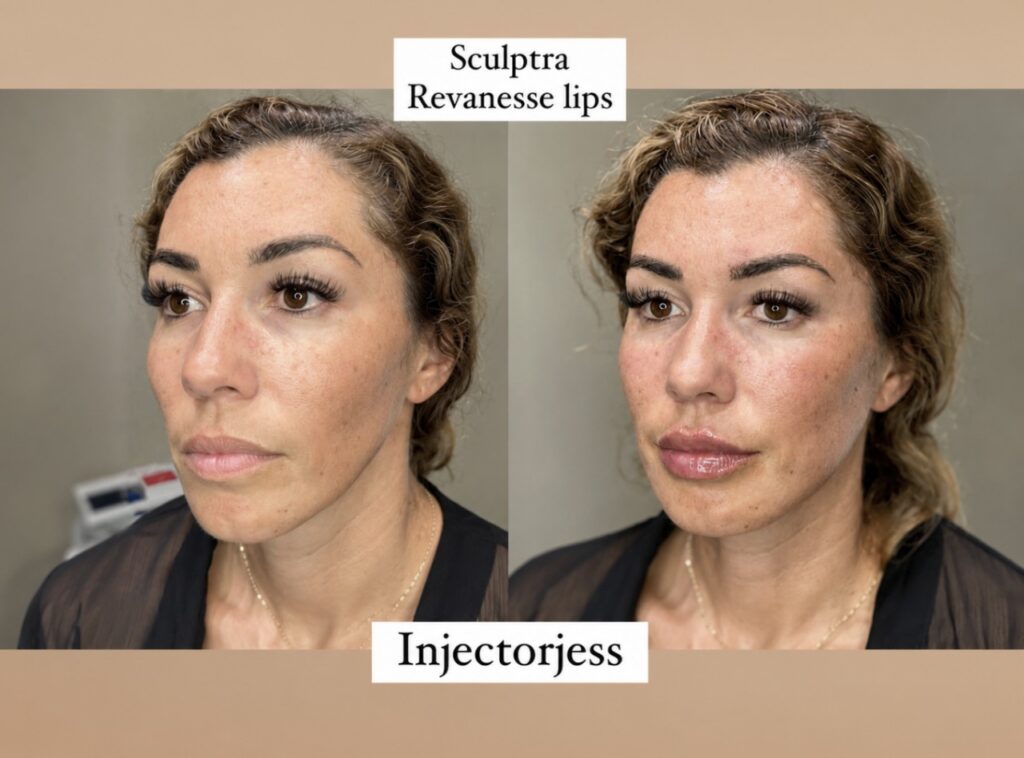
Both HyperDilute Radiesse and Sculptra require some patience.
These treatments are chosen partly for collagen stimulation, and collagen production does not happen overnight. The appearance you see immediately after an injection should not be confused with the eventual biological response.
With Sculptra, early fullness related to the injected solution can subside before the gradual effect becomes more noticeable. Treatment is commonly planned across multiple sessions, although the amount and number of appointments should be personalized.
HyperDilute Radiesse can also require a series. The recommended approach may vary with skin thickness, laxity, treatment area, degree of dilution, age, previous procedures, and your aesthetic goals.
You may see online comparisons claiming that HyperDilute Radiesse automatically means fewer sessions than Sculptra. That is too simple. Some patients may need fewer appointments with one treatment, but no reliable session count applies to everyone.
Results and longevity also vary from person to person. Your body has to participate in the collagen response, so two people receiving similar injections may not develop identical changes at the same pace.
That is one reason a good consultation looks beyond product names and focuses on the tissue being treated.
What to Expect During Treatment and Recovery
A collagen-stimulating injectable appointment should begin with an assessment, not a syringe.
Your provider will typically look at facial structure, skin quality, laxity, volume distribution, previous cosmetic procedures, and the areas you want to address. Medical history and relevant medications also matter when deciding whether treatment is appropriate.
During treatment, the provider prepares the skin and selects injection points and placement based on the chosen technique. HyperDilute Radiesse and Sculptra do not use one universal injection pattern, which makes anatomy knowledge particularly important.
Temporary injection site effects can include:
- Redness
- Swelling
- Bruising
- Tenderness
- Discomfort
- Temporary irregularity or palpable areas beneath the skin
Collagen stimulators can also carry risks such as nodules or other delayed reactions. As with other facial injectables, improper or accidental injection into a blood vessel can cause serious complications.
Treat biostimulators as medical procedures, even when the aesthetic goal is subtle and refined.
Your provider should discuss expected recovery, aftercare, potential risks, and symptoms that warrant medical attention based on the exact treatment performed. It is also important to disclose previous filler, threads, surgeries, or energy-based treatments before an injection plan is made.
Good technique protects more than safety. It also strongly influences how polished the final result looks.
Why Injector Choice Matters as Much as Product Choice

Choosing between Sculptra and Radiesse is only one part of creating a thoughtful result.
An experienced injector considers proportion, skin behavior, facial movement, structural support, and how one treated area will relate visually to the rest of your face. More product is not automatically more flattering.
This is where LUX Injectables takes a distinctly personal approach.
LUX is owned by Jessica Manges, ARNP, who has more than a decade of experience in dermatology and aesthetic medicine. Jessica has been nominated as a Top 100 Injector in America and has trained professionals at national and international levels. Her work includes combining PDO threads, neurotoxins, and dermal fillers.
At LUX, medical artistry and individualized planning guide the consultation. A patient concerned about facial aging may benefit from Sculptra. Another may be better suited to HyperDilute Radiesse. Someone else may need targeted filler, PDO threads, a skin treatment, or a staged combination.
The goal is an intentional plan that respects your features, not choosing an injectable just because it’s popular.
With that in mind, a few common questions can help clarify the comparison further.
Frequently Asked Questions About Hyperdilute Radiesse vs Sculptra
1. Is HyperDilute Radiesse better than Sculptra for loose skin?
Consider HyperDilute Radiesse when skin laxity, firmness, elasticity, and skin quality are major concerns. Sculptra can also contribute to firmer-appearing tissue, particularly when facial volume and structural support are part of the treatment goal.
Neither is automatically better. The decision depends on the cause and location of the changes you want to address.
2. Does HyperDilute Radiesse or Sculptra stimulate more collagen?
There isn’t enough direct comparative evidence to say one universally produces more collagen than the other.
CaHA and PLLA stimulate tissue through different processes. Treatment technique, dose, area, tissue quality, and individual biology can all affect the response.
3. Which lasts longer, Sculptra or HyperDilute Radiesse?
Both can produce changes that continue beyond the initial injection period because collagen stimulation develops over time. How long the visible effect lasts varies with the treatment protocol, area, number of sessions, age, tissue quality, and individual response.
Discuss a specific duration as an estimate, not a promise.
4. Can Sculptra and HyperDilute Radiesse be used in the same treatment plan?
They may both fit into a personalized aesthetic plan when an experienced medical provider determines that each treatment addresses a different need.
That doesn’t mean they should always be done together or during the same appointment. Consider timing, anatomy, treatment area, and previous procedures first.
5. How do I choose between Hyperdilute Radiesse vs Sculptra in Clearwater?
Start with the concern you see in the mirror.
If the priority is crepey skin, laxity, elasticity, or overall skin quality, HyperDilute Radiesse may be worth discussing. If the concern involves broader facial deflation, hollow areas, or gradual restoration of tissue support, Sculptra may be considered.
A consultation can determine whether either treatment fits your anatomy and aesthetic goals.
That final assessment turns a general comparison into a treatment plan designed specifically for your face.
HyperDilute Radiesse or Sculptra? Choose Based on Your Face, Not the Trend
The best answer to the HyperDilute Radiesse vs Sculptra question is rarely a universal winner.
HyperDilute Radiesse uses CaHA and can be a strong option to discuss when the focus is collagen and elastin support, skin quality, firmness, and laxity. Sculptra uses PLLA and may suit patients looking for gradual collagen stimulation with broader facial support or volume restoration.
Both require thoughtful patient selection, precise injection technique, and realistic expectations.
If you are considering collagen-stimulating injectables in Clearwater, schedule a free consultation with LUX Injectables and meet with Jessica to discuss your aesthetic goals. Your consultation can focus on what matters most, including your skin, facial proportions, treatment history, and the kind of result that feels right for you.

Jessica Manges, ARNP, is the founder and lead injector at LUX Injectables in Clearwater, Florida. With over a decade of experience in dermatology and aesthetic medicine, she specializes in PDO threads, neurotoxins, dermal fillers, and personalized treatment planning. Jessica has treated thousands of patients and has trained aesthetic professionals nationally and internationally.